Intense pulsed light · Myeongdong, Seoul
IPL photofacial in Myeongdong, Seoul
Broad-spectrum light that fades sun spots and freckles and softens redness in one treatment — a classic way to even out skin tone.
- Same price as locals
- English-speaking team
- Book on WhatsApp
- 中文 · 日本語
Quick answer
What is an IPL photofacial?
An IPL photofacial uses intense pulsed light, a filtered flash of many wavelengths, rather than a single-wavelength laser. Melanin in sun spots and haemoglobin in small vessels absorb the light, so brown spots darken and shed while diffuse redness gradually calms.
It suits sun-damaged or uneven skin with both brown and red tones. For deeper or stubborn pigment such as melasma, Seoul dermatologists usually prefer gentler options like laser toning.
Medically reviewed by Dr. Yoon Jong-woo , Medical Director, Umi Clinic (Korean-licensed physician) · Updated October 2026. Results vary by person; the doctor explains risks, side effects and alternatives at consultation.
- Session
- 20–30 min
- Numbing
- Usually not needed; cooling gel
- Downtime
- Little; spots darken for about a week
- Results
- Clearer tone after 1–2 weeks
- Sessions
- Typically 3–5, 3–4 weeks apart
- Pricing
- Same price as locals
Your visit
How IPL works at Umi
Every visit is doctor-led and explained in English, from the first skin check to aftercare.
- Consult & skin check
Spots and redness are assessed to rule out melasma or lesions that need another approach, and a filter is chosen.
- Cooling gel & eye shields
A thin layer of chilled gel is applied and your eyes are protected.
- Light pulses
The handpiece is moved across the face in gentle flashes that feel like a warm snap.
- Aftercare
Leave darkened spots to flake on their own, moisturise and use SPF 50 every day.
Before & after
How IPL evens skin tone
Light is absorbed by excess pigment and small vessels, which the skin then sheds or clears over the next couple of weeks.
Brown spots look slightly darker, like coffee grounds.
Darkened spots flake off naturally.
Brighter, more uniform complexion.
Is it right for you?
Who IPL suits best
Good fit if you…
- Have sun spots, freckles or age spots
- Have mild diffuse redness or flushing
- Want to even skin tone with little downtime
- Have light to medium skin without a recent tan
Consider another option if…
- You have melasma, which IPL can worsen — consider laser toning
- You have a fresh tan or deeper skin type
- You are pregnant or use photosensitising medication
- You have an active rash, infection or cold sore
Recovery & results
What to expect, step by step
- Same day
Mild warmth and pinkness; spots may darken within hours.
- First week
Darkened spots crust lightly and flake; make-up is fine.
- 2–4 weeks
Tone looks clearer; next session can be scheduled.
- Maintenance
One session every 6–12 months, with strict sun protection.
FAQ
IPL questions
Is IPL the same as a laser?
No. A laser emits one wavelength, while IPL emits a broad band of light filtered for the target. That lets IPL treat brown and red tones together, but with less precision than a dedicated laser.
Can IPL treat melasma?
Usually not. IPL heat can trigger melasma to darken, so the doctor will normally recommend low-energy laser toning or topical care instead.
How soon can I go in the sun?
Avoid strong sun for at least 2 weeks and use broad-spectrum SPF 50 daily, especially while sightseeing.
How many IPL sessions will I need?
Most people see a good result after 3–5 sessions spaced 3–4 weeks apart; even one session can lighten several spots.
Do foreigners pay more?
No. International patients pay the same price as local patients at Umi Clinic.
Related at Umi Clinic
Explore next
Related laser treatments
Concerns it helps
Plan your visit
Ask about IPL in English
Send a photo and your travel dates on WhatsApp — the team replies with a plan and a same-as-locals price.
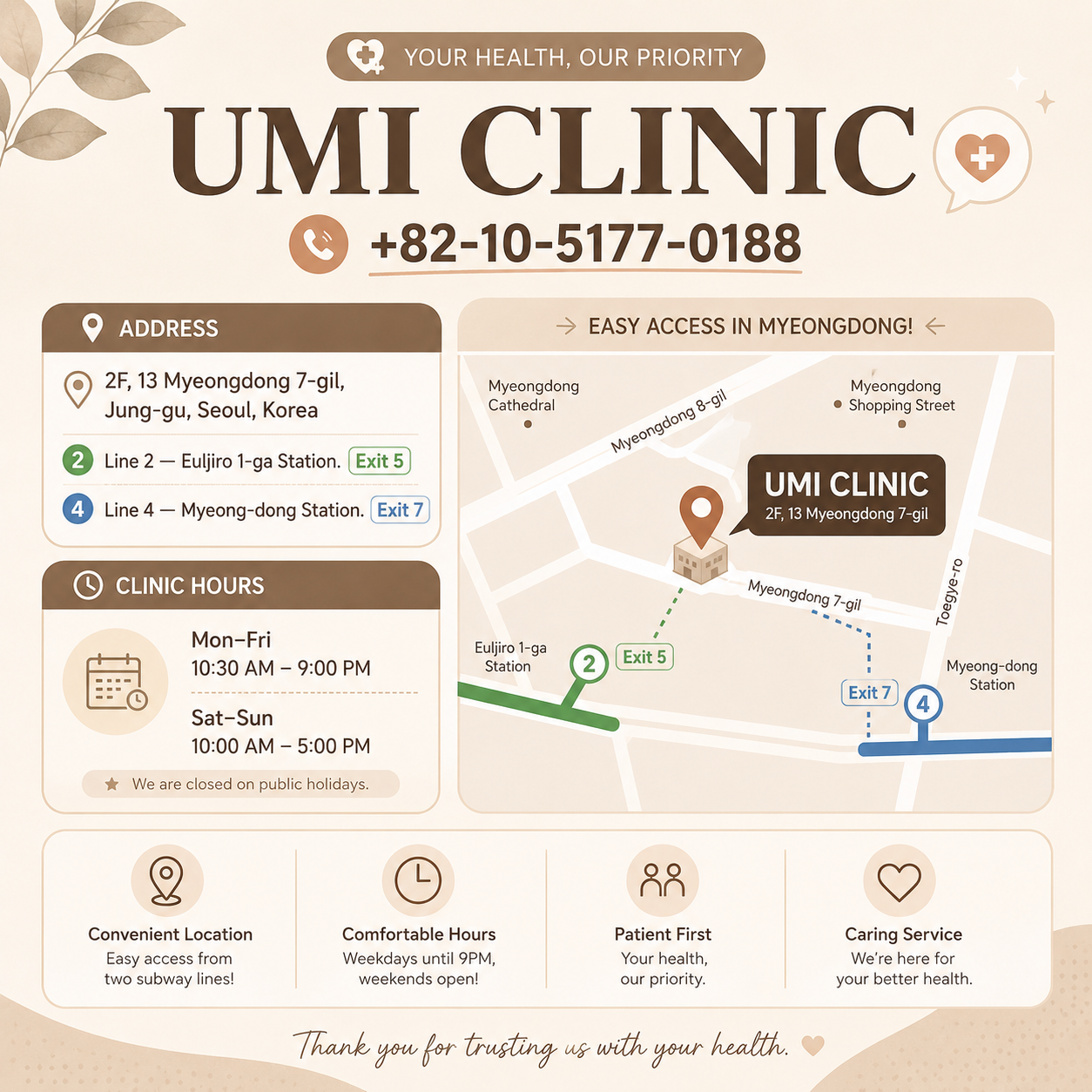
Umi Clinic (우미의원) · 13 Myeongdong 7-gil, Jung-gu, Seoul · Near Myeongdong Station Exit 6 · Directions & hours